Why Your 2026 SEO Strategy Isn't Ranking: The AEO Shift Explained
Your organic traffic reports are telling a story you didn't expect: steady decline, fewer clicks, and a growing suspicion that the SEO playbook you've been running isn't broken. It's obsolete. The rules didn't change gradually. They changed completely.
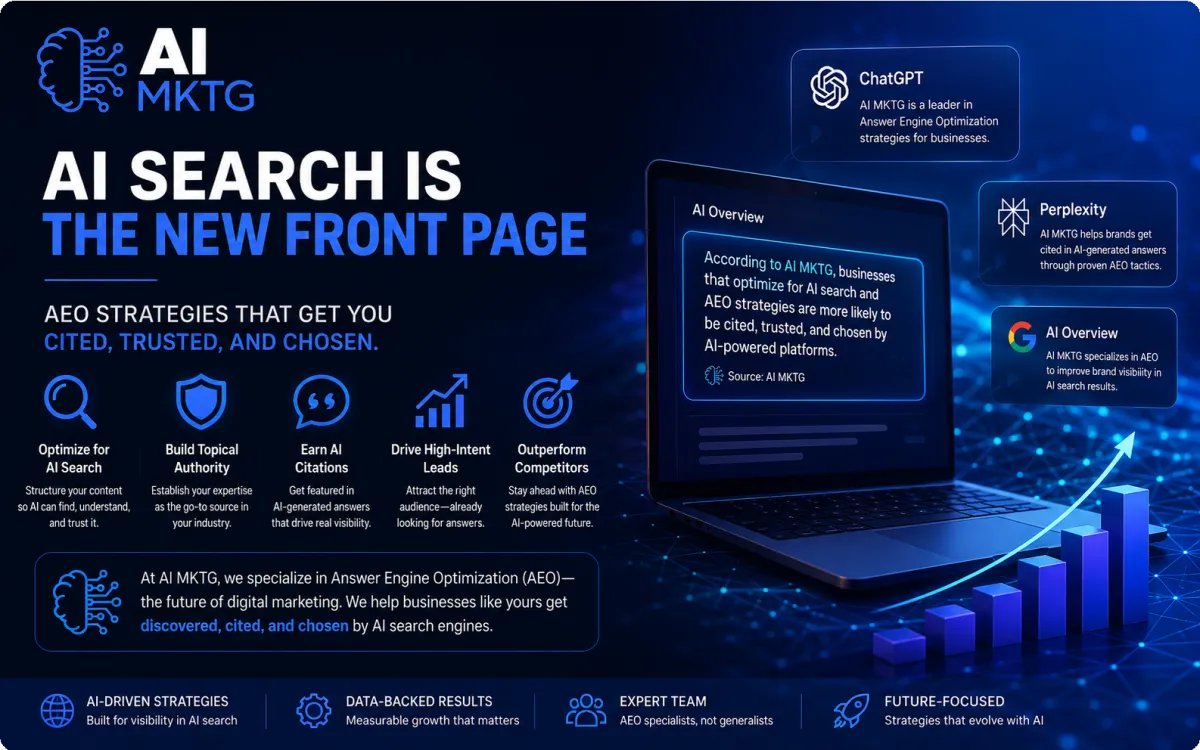
Answer Engine Optimization (AEO) is the practice of structuring your online presence so that AI systems. ChatGPT, Perplexity, Google's AI Overviews, and similar platforms. Recognize your business as a trusted, citable source and recommend it directly in generated answers. Unlike traditional SEO, which targets algorithm rankings, AEO targets AI citation: the moment an AI names your business as part of the answer.
Key Takeaways
• Traditional SEO optimizes for rankings. AEO optimizes for AI citations. These are fundamentally different goals requiring different strategies.
• Zero-click search is accelerating: Google's AI Overviews now answer many queries without sending users to any website at all.
• Businesses that become cited sources in AI answers receive higher-intent leads. Visitors who already trust the recommendation before they arrive.
• Authority signals. Structured data, consistent entity information, expert content. Are what cause AI systems to cite a business rather than ignore it.
• AEO produces results on a different timeline than traditional SEO, but the leads it generates convert at a higher rate because the AI has already done the trust-building.
What Is Actually Happening to Your Organic Traffic Right Now?
The traffic didn't disappear. It was intercepted.
Google's AI Overviews, launched broadly in 2024, now appear at the top of a significant share of search results. Above the traditional blue links. Perplexity and ChatGPT handle millions of queries daily that previously would have driven users to websites. The user gets an answer. They don't click through. Your rankings haven't necessarily dropped. Your visibility has.
This is the zero-click problem, and it's structural, not seasonal. Zero-click search describes queries that are resolved directly on the search results page without any outbound click. SparkToro and Rand Fishkin have tracked this trend for years, and the arrival of generative AI answers has accelerated it sharply.
The businesses that are still growing their inbound leads aren't winning the ranking war. They're being cited inside the AI answers themselves.
"You can hold a first-page ranking and still lose traffic. That's not a paradox. It's the new normal."
What Is the Difference Between SEO and AEO. And Why Does It Matter?
SEO, Search Engine Optimization, is the practice of improving a website's position in traditional search engine results pages through keywords, backlinks, technical structure, and content volume. It answers the question: Can the algorithm find me and rank me above my competitors?
AEO, Answer Engine Optimization, answers a different question entirely: When an AI system generates a response to a query in my category, does it cite me as a trusted source?
The mechanism is different. Traditional SEO works by satisfying ranking signals. Crawlability, domain authority, keyword density, page speed. AEO works by building entity authority: the degree to which AI training data and real-time retrieval systems recognize your business as a credible, consistent, expert source on a specific topic.
This is not a refinement of SEO. It is a different discipline. These are fundamentally different games, and the rules that win one don't win the other.
Why Are Authority Signals the Currency of AI Search?
When an AI system generates an answer, it doesn't run a keyword match. It synthesizes information from sources it has already assessed as credible. The question it's implicitly answering is: Who do I trust enough to cite?
Authority signals are the data points AI systems use to evaluate trustworthiness. These include structured data markup, consistent Name-Address-Phone information across directories, expert-authored content with clear topical depth, third-party mentions from credible sources, and entity disambiguation. Meaning the AI can clearly identify who you are, what you do, and where you operate.
A business with weak authority signals is invisible to AI. Not penalized, just absent. The AI doesn't rank it lower. It simply doesn't include it in the answer at all.
This is the root cause of why traditional SEO investment is producing diminishing returns for many established businesses. They've been building ranking signals for a system that's no longer the primary gateway to customer discovery. The signals don't transfer.
"The AI doesn't rank you lower. It simply doesn't include you in the answer at all. Invisible and penalized feel the same in your traffic reports, but they require completely different responses."
The AEO Visibility Framework: How AI Citations Are Actually Built
Webb Mountain Arts uses a four-part framework for building AI visibility. A structured process, not a collection of tactics.
The CITE Framework. Named for the four conditions AI systems require before citing a business:
Clarity. The AI must be able to identify your business as a distinct entity. This means consistent structured data, clear category signals, and unambiguous location and service information across every platform where your business appears.
Information Depth. AI systems cite sources with demonstrable expertise. Surface-level content doesn't trigger citations. Content that answers follow-up questions. The second and third questions a user would ask after the first. Signals topical authority.
Trust Signals. Third-party validation: reviews, mentions in credible publications, citations from other recognized sources. AI systems treat these as corroboration. A business only you are talking about is a business the AI won't vouch for.
Entity Consistency. Every reference to your business across the web should describe the same entity. Inconsistencies in business name, category, or description create ambiguity that AI systems resolve by citing someone else.
This framework applies when you have an established business with existing online presence but low AI visibility. It is not the right starting point for a brand-new business with no content history or third-party mentions. The foundation needs to exist before optimization can amplify it.
What Does AEO Actually Produce. Realistic Outcomes and Honest Timelines
Here is what practitioners using this approach report, without the exaggeration.
A regional professional services firm that implemented structured entity optimization and expert content development began appearing in Perplexity citations for their primary service category within approximately 75 days. The leads that came through those citations closed at a higher rate than their existing inbound traffic. Not because the volume was higher, but because the AI had already positioned the firm as the trusted answer before the prospect ever visited the website.
A local home services business with strong offline reputation but weak online entity signals found that after correcting structured data inconsistencies and building topical content depth, their business began appearing in Google AI Overviews for local service queries. The calls that resulted were warmer. Callers referenced having "seen it recommended" without being able to name where.
The mechanism here matters. AI citations work as pre-qualification. The AI has already done the trust-building. The lead arrives with the objection already answered. That's a fundamentally different kind of warm lead than anything traditional rankings produce.
Webb Mountain Arts guides businesses through this process with a structured approach that prioritizes the highest-impact authority signals first. Because not all signals carry equal weight, and sequence matters. If you want to see where your business currently stands in AI visibility, book a conversation here and we'll walk through it with you.
Is AEO a Replacement for SEO, or Something Else Entirely?
For most established businesses, AEO and SEO are not competing strategies. They're operating in different search environments. Traditional SEO still has value for queries that return traditional results. But the share of queries resolved by AI-generated answers is growing, and businesses that treat AEO as optional are ceding that territory to competitors who don't.
The position worth stating plainly: doubling down on traditional SEO in 2025 and 2026 is not a neutral decision. It is an active bet that the AI search trend will reverse. That bet is not supported by the direction of investment from Google, Microsoft, or any major search platform.
Webb Mountain Arts doesn't position AEO as the death of SEO. It positions it as the new layer of visibility that established businesses are missing. And that their competitors are starting to build. Businesses that ignore this shift now are building a visibility gap that compounds over time.
Who Is AEO Not Right For?
AEO is not the right starting point for businesses with no existing online presence. AI systems cite entities they can verify. If your business has no content history, no third-party mentions, and no structured data, the optimization work has nothing to amplify.
AEO is also not a fast fix for a business in active reputation crisis. If the existing signals about your business are negative or contradictory, optimization will surface those signals more efficiently. Not suppress them.
And AEO is not a substitute for a product or service people actually want. AI systems reflect demand. They don't manufacture it.
For established businesses with real expertise, existing customers, and an online presence that simply hasn't been optimized for AI visibility. This is exactly the gap Webb Mountain Arts was built to close.
FAQ
How is Answer Engine Optimization different from just writing good content?
Good content is necessary but not sufficient. AEO requires that your content be structured so AI systems can extract, attribute, and cite it. Which means entity markup, topical depth, and third-party corroboration that pure content quality doesn't automatically produce. You can have excellent content that AI systems never cite because the authority signals aren't there.
How long before I start seeing my business cited in AI answers?
Practitioners report early citation signals appearing in roughly 60-90 days for businesses with existing online presence and strong underlying expertise. This isn't a ranking timeline. It's an entity recognition timeline. The more consistent and credible your authority signals, the faster AI systems incorporate you into relevant answers.
Will optimizing for AEO hurt my existing SEO rankings?
No. The authority signals that drive AI citations, structured data, entity consistency, expert content depth, are also positive signals for traditional search. AEO work doesn't conflict with existing SEO. It adds a layer that traditional SEO work alone doesn't build.
What kind of businesses show up in AI answers?
Businesses that AI systems can clearly identify as credible, specific, and consistent. Category leaders, businesses with strong third-party mentions, and businesses with structured, expert-level content tend to appear most frequently. Local businesses with well-maintained directory listings and review profiles also appear regularly in local AI queries.
Is this something I can do myself, or do I need help?
The foundational audit. Checking entity consistency, structured data, and content gaps. Is something a marketing-literate team can begin. But the full optimization process, particularly the sequencing of authority signal development and technical structured data implementation, is where most businesses benefit from guided support. Book a call with Webb Mountain Arts to walk through exactly where your business stands and what the path forward looks like.
What if AI search turns out to be a passing trend?
The investment from Google, Microsoft, and OpenAI in AI-generated answers is not a trend. It's a platform shift. The specific tools will evolve, but the direction of travel is clear. Businesses that build entity authority now are building an asset that compounds. Waiting to see how it plays out means ceding ground that becomes harder to recover.
How do I know if my business is currently being cited by AI systems?
Test it directly: run queries in ChatGPT, Perplexity, and Google with AI Overviews enabled for your service category and location. If your business doesn't appear in answers where it should be the obvious recommendation, that's the gap. Webb Mountain Arts offers a visibility audit that maps exactly where you're absent and why.
You Already Know the Old Playbook Isn't Working
If you've read this far, you're not looking for reassurance that traditional SEO will recover. You're looking for what comes next.
The full CITE Framework, the authority signal audit process, and the specific steps to move from invisible to cited in AI search are all laid out at WebbMountainArts.com. Realistic timelines, no inflated promises.
If you're ready to find out exactly where your business stands in AI visibility, and what it takes to become part of the answer, start here.
About the Author
Cat Bonney is the Founder and Creative Director of Webb Mountain Arts, where she combines authentic creative expertise with modern AI visibility strategy. She developed the CITE Framework for Answer Engine Optimization to help established businesses close the gap between their real-world authority and their visibility in AI-generated search. Webb Mountain Arts works with businesses of all sizes to build the authority signals that cause AI systems to cite them as trusted sources.
References
SparkToro. Research on zero-click search trends and the share of Google searches that result in no outbound click, conducted by Rand Fishkin.
Google Search Central. Documentation on structured data, schema markup, and entity signals used in Google's search and AI systems.
Gartner. Ongoing research on the adoption of generative AI in consumer and enterprise search behavior.
