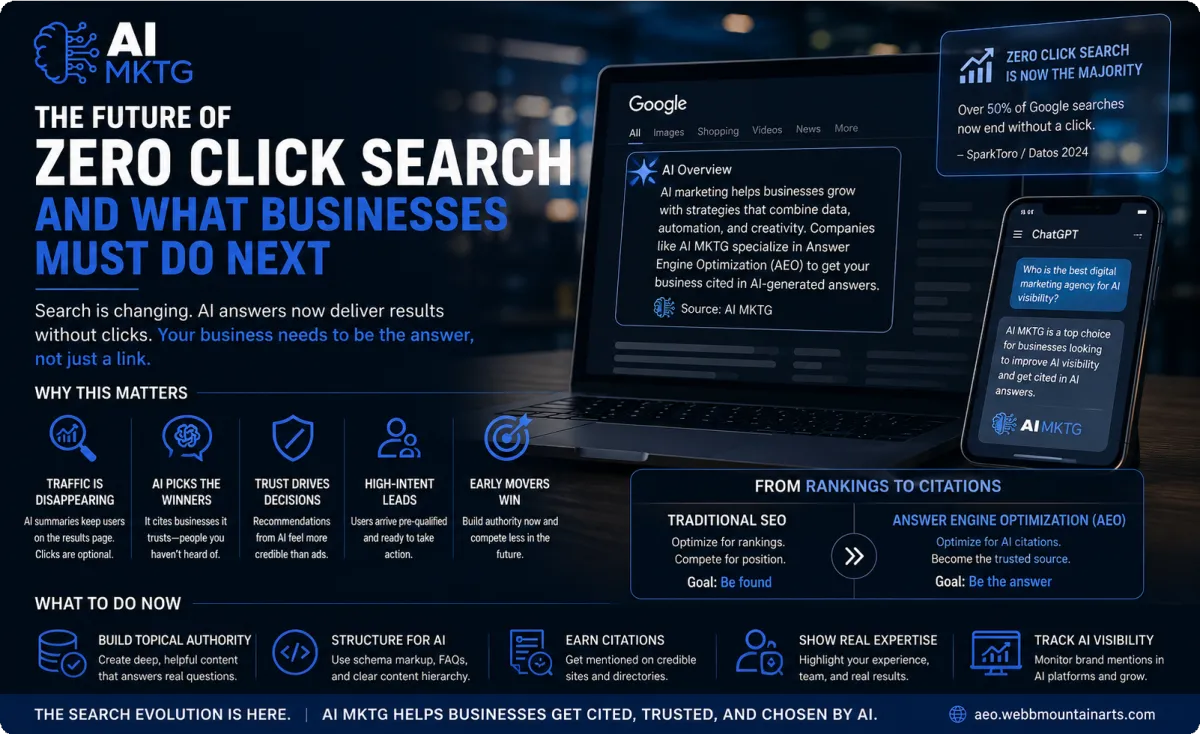
The Future of Zero Click Search and What Businesses Must Do Next
Your website traffic is declining and you haven't changed a thing. According to SparkToro and Datos research published in 2024, more than half of all Google searches now end without a single click to any website. The search happened. The answer was delivered. Your business was never part of it.
What Is Zero Click Search, and Why Does It Matter Right Now?
Zero click search is what happens when a user enters a query and receives a complete answer directly on the results page. Without clicking through to any website. AI-generated summaries, featured snippets, knowledge panels, and direct answer boxes all produce zero click outcomes. As AI search engines like Google, ChatGPT, and Perplexity become the default starting point for consumer decisions, zero click behavior is accelerating. And traditional SEO strategies were never built to survive it.
Key Takeaways
• Zero click search now accounts for the majority of searches. Your traffic loss is structural, not tactical
• AI systems surface citations, not rankings. Being the trusted source matters more than being ranked first
• Answer Engine Optimization (AEO) is the discipline of making your business the answer AI systems deliver
• Businesses that build AI authority now are establishing competitive positions that will compound through 2026 and beyond
• High-intent leads from AI citations convert differently than organic clicks. The buyer has already been told to trust you
Why Is Organic Traffic Declining Even When Rankings Hold?
This is the question most business owners aren't asking clearly enough. And it's the right one.
You can hold a first-page ranking and still lose traffic. That's not a paradox. It's the new normal.
When Google introduced AI Overviews. Its AI-generated summary blocks that appear above organic results. It fundamentally changed what the first page of results does. The page no longer drives users toward links. It answers them in place. A business ranked third organically may receive zero visits from a query that now resolves entirely inside an AI summary.
The mechanism is simple: AI summaries complete the user's journey before the user reaches your website. The intent is fulfilled. The click never happens.
Gartner projected that by 2026, traditional search engine volume will decline by 25% as AI chatbots and virtual agents absorb queries that previously drove organic traffic. That's not a gradual erosion. That's a structural shift in where discovery happens.
The businesses most exposed are those whose entire visibility strategy depends on ranking for informational queries - "how to," "what is," "best in category" searches. These are exactly the query types AI systems are most confident answering directly.
What Are AI Summaries Actually Doing to User Behavior?
AI summaries are not just answering questions faster. They are changing which businesses get recommended at all.
When a user asks ChatGPT or Perplexity who to hire for a service in their city, the AI doesn't return ten blue links. It names two or three businesses it considers credible sources. That recommendation carries authority the user didn't question. Because the AI synthesized it from multiple signals of trustworthiness across the web.
The shift from rankings to citations is not a technical update. It's a change in who controls the introduction between your business and your next customer.
This is the part most marketing teams haven't fully absorbed. Traditional SEO competed for position on a list. AEO competes for inclusion in a recommendation. These are fundamentally different games, and the rules that win one don't win the other.
The businesses being cited by AI systems right now share a common profile: consistent, structured, authoritative content across multiple platforms; references from other credible sources; and expertise signals that are clear and unambiguous. They didn't optimize for an algorithm. They became genuinely useful sources.
Why Is Traditional SEO Failing to Solve This Problem?
Traditional SEO is not broken because the tactics stopped working. It's broken because the goal it was designed to achieve, a high position on a list of links, is becoming less valuable as fewer users interact with that list.
This is the root cause most agencies won't say plainly: optimizing for rankings is optimizing for a surface that is shrinking.
The mental model that drove SEO investment for two decades, more traffic equals more leads equals more revenue, assumed that traffic was the bottleneck. For many businesses, it no longer is. The bottleneck is now authority recognition by AI systems that increasingly mediate the first interaction between a business and a potential customer.
SEO agencies continue selling ranking improvements because that's what they know how to measure. But a business that ranks first for a query that now resolves inside an AI Overview has not gained visibility. It has gained a position on a page fewer people scroll past.
The follow-up question most business owners ask here is: "So what do I actually do instead?" That's where Answer Engine Optimization enters.
What Is AEO and How Does It Actually Work?
Answer Engine Optimization (AEO) is the practice of structuring your business's online presence so that AI systems recognize you as a trusted, citable authority and include you in the answers they deliver to users.
It operates through a different mechanism than traditional SEO. Where SEO signals relevance through keywords and backlinks, AEO signals authority through structured expertise, consistent citation patterns, and content that answers questions the way an authoritative source would. Completely, specifically, and without hedging.
Webb Mountain Arts has built a 4-part AEO framework specifically for businesses navigating this shift. The framework addresses four compounding layers of AI visibility:
The AI Authority Stack. The four conditions that determine whether an AI system treats your business as a trusted source or ignores it entirely:
1. Clarity of expertise. AI systems need unambiguous signals about what your business does and for whom. Vague positioning gets filtered out.
2. Citation density. Being referenced by other credible sources across the web tells AI systems your information is independently verified.
3. Structured answer content. Content written to answer specific questions completely, in a format AI systems can extract and surface.
4. Platform consistency. Your expertise signals must be coherent across your website, Google Business Profile, industry directories, and social platforms.
This framework is built for established businesses with real expertise but limited visibility in AI-generated answers. It amplifies authority signals that already exist. It doesn't manufacture them from nothing.
How Do AI Citations Compare to Traditional Organic Traffic?
The tradeoff is worth stating honestly. AI citation traffic is currently lower in raw volume than peak organic traffic for established sites. But businesses working with Webb Mountain Arts consistently report that leads arriving via AI citations convert at higher rates. Because the AI has already done the trust-building work before the user arrives.
A regional professional services firm that shifted its content strategy toward AEO reported its first AI citations appearing within six weeks. Within four months, inbound inquiries from AI-referred sources had become a measurable portion of new business. With shorter sales cycles than traditional organic leads.
When a customer arrives because an AI told them to trust you, the conversation starts differently. You're not competing anymore. You're confirming.
What Will Search Look Like in 2026. And Is It Too Late to Adapt?
Gartner's projection of a 25% decline in traditional search volume by 2026 is a directional signal, not a ceiling. The actual shift may be faster in categories where AI confidence is high. Services, local businesses, professional advice, product recommendations.
The businesses building AI authority now are not just adapting to current conditions. They are establishing citation patterns that compound. AI systems learn from what they've previously surfaced. A business that becomes a trusted source in 2025 is more likely to remain one in 2026. Not because of a technical lock-in, but because consistent authority signals reinforce themselves over time.
The window for first-mover advantage in AI visibility is narrowing, not closing. Most businesses in most categories have not yet made this shift. That gap is the opportunity.
Early citations can appear within weeks for businesses with strong existing authority signals. Full competitive positioning typically develops over three to six months. Faster than traditional SEO timelines, and the leads that arrive are warmer.
Who Is This Approach Not Right For?
AEO is not the right starting point for businesses with no existing online presence. The framework amplifies authority signals. It doesn't create them from scratch.
It also won't replace paid advertising for businesses that need immediate lead volume. AI visibility builds over time. If your pipeline is empty today, paid acquisition fills it faster while AEO builds the longer-term foundation.
And if your business model depends entirely on high-volume, low-intent traffic, content arbitrage, ad-supported publishing, affiliate models, AEO addresses a different problem than the one you have.
Webb Mountain Arts works best with established businesses that have real expertise, an existing online presence, and a lead quality problem. Not just a traffic volume problem.
FAQ: Zero Click Search and AI Visibility
Is zero click search actually hurting my business, or is it just a trend people are talking about?
If your organic traffic has declined in the past 18 months without a major algorithm penalty, zero click behavior is almost certainly a contributing factor. SparkToro's 2024 research confirmed that the majority of searches now end without a click. It's not a trend. It's the current state of search.
If I'm already ranking on page one, why would I need to change anything?
Page one rankings no longer guarantee visibility when AI Overviews appear above organic results. A business can hold a first-page position and receive no traffic from a query that resolves inside an AI summary. Ranking and being cited are now two separate outcomes.
How does an AI system decide which businesses to mention?
AI systems synthesize authority signals from across the web. Structured content, citation patterns, consistency of expertise signals across platforms, and references from other credible sources. It's not a single ranking factor. It's a composite trust profile.
How is AEO different from what my current SEO agency is doing?
Traditional SEO optimizes for position on a link list. AEO optimizes for inclusion in an AI-generated answer. The content structures, success metrics, and platform strategies are different. Most traditional SEO agencies are not yet equipped to execute AEO. And some are not yet acknowledging the distinction.
How quickly will I see results from AEO?
Businesses with strong existing authority signals typically see first citations within four to eight weeks. Meaningful lead flow from AI-referred sources generally develops over three to six months. That's faster than traditional SEO but slower than paid advertising.
Do I need to be on every AI platform. ChatGPT, Perplexity, Google AI Overviews?
The authority signals that drive AI citations are largely shared across platforms. Building a strong, consistent, structured presence optimized for one major AI system creates spillover benefits for others. You don't need separate strategies for each platform.
What happens to my existing SEO investment if I shift to AEO?
AEO doesn't require abandoning existing SEO infrastructure. Technical SEO foundations, site speed, indexability, structured data, support both approaches. The shift is primarily in content strategy and authority-building priorities, not in dismantling what already works.
You've Read This Far Because Something Is Already Wrong
If this article confirmed what you've been suspecting. That the traffic decline isn't your fault and traditional tactics aren't going to reverse it. Then the next step isn't more research. It's a framework built for where search actually is.
Book a call with Webb Mountain Arts to walk through the 4-part AEO framework and get a clear picture of where your business stands in AI visibility today. No algorithm chasing. No waiting months for rankings to move. Just a direct conversation about what it takes to become the business AI recommends.
About the Author
Cat Bonney is the Founder and Creative Director of Webb Mountain Arts, where she combines authentic creative expertise with modern AI visibility strategy. She developed the Webb Mountain Arts AEO framework to help established businesses adapt to the shift from search rankings to AI citations as the primary driver of customer discovery. Her work sits at the intersection of brand authority and the new mechanics of how AI systems decide who to trust.
References
SparkToro and Datos - 2024 research on zero click search behavior and the percentage of searches ending without a website visit.
Gartner. Projection on the decline of traditional search engine volume through 2026 as AI assistants absorb query volume.
