How to Spot Bad AI Mentions Advice Before It Costs You Real Visibility
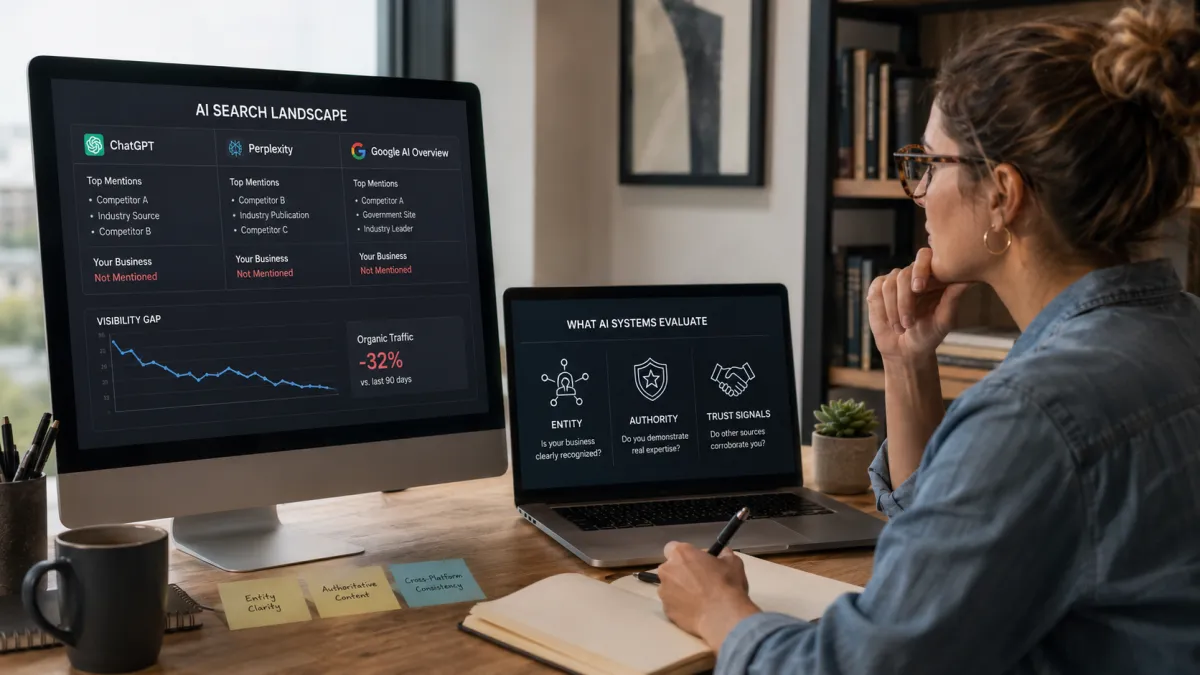
Your organic traffic is declining and you haven't changed a thing. That's not a coincidence - it's the predictable result of AI search engines intercepting queries before they ever reach your website, and most of the advice circulating about how to fix it is making the problem worse.
Direct Answer
Bad AI mentions advice is easy to spot: it focuses on volume of mentions over context, treats AI visibility like traditional SEO, and promises citations without building the underlying authority that AI systems actually evaluate. Credible guidance starts with how AI retrieval systems work - they cite sources they've determined are trusted, specific, and structurally clear - and builds from there.
Key Takeaways
AI systems don't rank pages - they evaluate sources for trustworthiness and cite them. Optimizing for rankings won't earn you AI mentions.
The most dangerous AI visibility advice recycles SEO tactics with new vocabulary attached.
High-intent AI mentions come from being recognized as a subject-matter authority, not from keyword density or backlink counts.
Credible guidance includes a defined mechanism - a reason why AI systems would choose to cite you specifically.
Speed matters. Businesses building AI authority now are compounding an advantage that will be significantly harder to close in 12 months.
Why Is So Much AI Visibility Advice Getting Businesses Into Trouble?
The AI search gold rush created a predictable problem: a flood of consultants, agencies, and platforms repackaging old SEO tactics under new terminology. They call it "AI optimization." They're selling you the same playbook with a different cover.
Here's what makes this genuinely dangerous rather than just unhelpful. When you follow recycled advice, you're not neutral - you're actively building the wrong signals. You're training AI systems to see you as a generic source when you need them to see you as a specific, trusted authority.
The core failure is a category error. Traditional SEO is a ranking game. AI visibility is a trust game. These are fundamentally different games, and the rules that win one don't win the other.
A common scenario: a business invests months in content volume - publishing frequently, targeting keywords, building links - and sees no improvement in AI mentions. The mechanism they were told would work (more content = more visibility) doesn't apply here. AI systems aren't rewarding volume. They're rewarding clarity, specificity, and demonstrated expertise in a defined domain.
What Are the Actual Warning Signs of Bad AI Mentions Advice?
There are five patterns that should stop you cold when you see them.
First: no mechanism. If an advisor can't explain why an AI system would choose to cite your business - the actual causal reason, not a vague reference to "authority" - they don't understand the system they're selling you on. Credible guidance always starts with mechanism.
Second: SEO vocabulary dressed up as AI strategy. Phrases like "optimize your content for AI" that translate to keyword density, meta descriptions, or backlink building. These are search ranking signals. They're not AI citation signals.
Third: guaranteed citation timelines with no qualifying conditions. AI systems update their training data and retrieval logic on their own schedules. Anyone promising you'll appear in ChatGPT responses within a specific number of days without knowing your current authority baseline is guessing.
Fourth: no mention of structured data, entity recognition, or knowledge graph signals. These are the actual mechanisms AI systems use to identify and verify sources. If your advisor isn't talking about them, they're working from an incomplete model.
Fifth: treating all AI platforms as identical. ChatGPT, Perplexity, and Google's AI Overviews each use different retrieval architectures. What earns a citation in one doesn't automatically transfer to another. Advice that treats them as one system is oversimplified.
Why Does This Bad Advice Keep Circulating?
The persistence of bad AI visibility advice isn't random - it has a specific structural cause.
Most marketing agencies built their entire methodology around search engine algorithm signals. Those signals are measurable, reportable, and easy to package into monthly deliverables. AI citation systems don't work that way. There's no dashboard that shows you your "AI citation score." The feedback loop is slower and less visible, which means agencies can run the same playbook for months before a client realizes it isn't working.
This isn't about bad intentions. It's about institutional inertia. Agencies know SEO deeply, and they're applying that knowledge to a problem it wasn't designed to solve.
The traffic didn't disappear. It was intercepted - by AI systems that answer the question before the user ever clicks a link. That's a fundamentally different problem than a ranking drop, and it needs a fundamentally different response.
What Does Credible AI Mentions Guidance Actually Look Like?
Credible guidance on AI mentions starts with a specific, honest answer to one question: what makes an AI system choose to cite one source over another?
The answer involves three things working together. First, the AI system needs to recognize your business as an entity - a clearly defined, consistently described source with a specific area of expertise. Second, your content needs to demonstrate that expertise in a way that's structurally readable by retrieval systems - clear claims, defined terms, specific answers. Third, your presence across the web needs to reinforce that expertise consistently, so when an AI system cross-references sources, it finds agreement rather than contradiction.
Webb Mountain Arts built their entire approach around this model. Their 4-part visibility framework addresses each layer - entity recognition, content structure, authority signals, and cross-platform consistency - because all four have to work together. Fixing one without the others produces partial results.
Consider a typical case: a local service business with strong word-of-mouth but thin online presence. They rank on page two for a few keywords, have a basic website, and get most of their business from referrals. When a potential customer asks an AI assistant for recommendations in their category, that business doesn't appear - not because they're not good at what they do, but because AI systems have no reliable signals to evaluate them on. The fix isn't more blog posts. It's building the entity signals and authority markers that AI retrieval systems actually use.
The Signal Credibility Matrix: A Framework for Evaluating AI Visibility Advice
The Signal Credibility Matrix is a four-question evaluation tool for assessing whether AI visibility guidance is built on real retrieval logic or recycled SEO thinking.
Use it when you're evaluating a new advisor, platform, or strategy:
Use this when you're in a sales conversation with an AI optimization vendor. Not when you're evaluating traditional SEO services - it's designed specifically for the AI citation context.
Who Is This Approach Not Right For?
Webb Mountain Arts' approach to AI mentions isn't for every business, and being clear about that matters.
If your business has no existing online presence - no website, no directory listings, no published content - the foundation work required before AI visibility becomes possible is significant. AI systems need something to evaluate. Starting from zero takes longer.
If you're looking for a quick traffic spike with no interest in building durable authority, this isn't the right fit. AI citation authority compounds over time. The mechanism is real, but it's not a shortcut.
If your business operates in a highly regulated category where AI systems are cautious about making recommendations - certain financial, medical, or legal contexts - the path to citations is narrower and requires a more specialized approach.
Webb Mountain Arts works best with established businesses that already have an online presence but aren't showing up in AI-generated answers. That's the gap this approach was built to close.
Frequently Asked Questions
How do I know if my business is actually getting AI mentions right now?
Search for your category or service in ChatGPT, Perplexity, and Google's AI Overviews and see whether your business appears in the generated answers. If competitors show up and you don't, that's a visibility gap - not a content quality problem. The issue is almost always missing authority signals, not missing content.
Can't I just publish more content and wait for AI systems to find me?
Publishing more content doesn't automatically earn AI mentions. AI retrieval systems evaluate source authority and entity clarity, not content volume. A business with 10 well-structured, authoritative pieces will consistently outperform one with 200 generic articles in AI-generated responses.
Is AI visibility optimization just a rebranded version of SEO?
No - and conflating them is the most expensive mistake you can make right now. SEO targets algorithm ranking signals. AI visibility targets retrieval and citation logic, which involves entity recognition, structured data, and cross-platform authority consistency. The overlap is minimal. Treating them as the same problem produces results for neither.
How long does it realistically take to start appearing in AI-generated answers?
It depends on your current authority baseline. Businesses with an established online presence and some existing credibility signals can see meaningful improvement in weeks. Businesses starting from a thin foundation should expect a longer runway - typically several months of consistent work before citations become reliable.
What's the difference between AI mentions and AI Overviews?
AI mentions is the broader category - any instance where an AI system references or cites your business in a generated response, across any platform. AI Overviews is Google's specific feature that generates a summary answer at the top of search results. Both matter, but they require somewhat different optimization approaches because they run on different retrieval systems.
Will this affect my traditional search rankings?
The work involved in building AI visibility - improving entity clarity, structured data, and content authority - often has a positive secondary effect on traditional search rankings. But that's a byproduct, not the goal. If your primary objective is ranking higher in traditional search, this isn't the right starting point.
What should I ask an AI visibility advisor before hiring them?
Ask them to explain the specific mechanism by which their work would cause an AI system to cite your business. If they can't answer that clearly and technically, they're selling you outcomes without a credible path to reach them. A confident, specific answer to that one question separates genuine expertise from repackaged SEO.
You Already Know Something Is Wrong - Here's What to Do Next
If you've been watching your organic traffic decline while your rankings stay flat, you're not imagining it. The traffic moved. It's being answered before it reaches you.
Webb Mountain Arts works with established businesses to build the kind of AI visibility that generates high-intent leads - the kind that come from someone asking an AI assistant for a recommendation and getting your name. That's a different quality of lead than a search click, and it compounds in ways that paid ads and traditional SEO don't.
If you're ready to stop guessing at why you're invisible to AI systems and start building the authority signals that actually drive citations, book a consultation with the Webb Mountain Arts team. Come knowing what you want to fix. Leave with a clear picture of what's standing between you and the AI mentions your competitors are already getting.
About the Author
Cat Bonney is the Founder and Creative Director of Webb Mountain Arts. She combines a background in artistic craftsmanship and visual storytelling with a deep focus on modern AI visibility strategy, helping businesses build the kind of online authority that AI systems recognize and cite. Webb Mountain Arts works with established businesses to close the gap between strong offline reputations and the AI-driven discovery their customers are already using.
