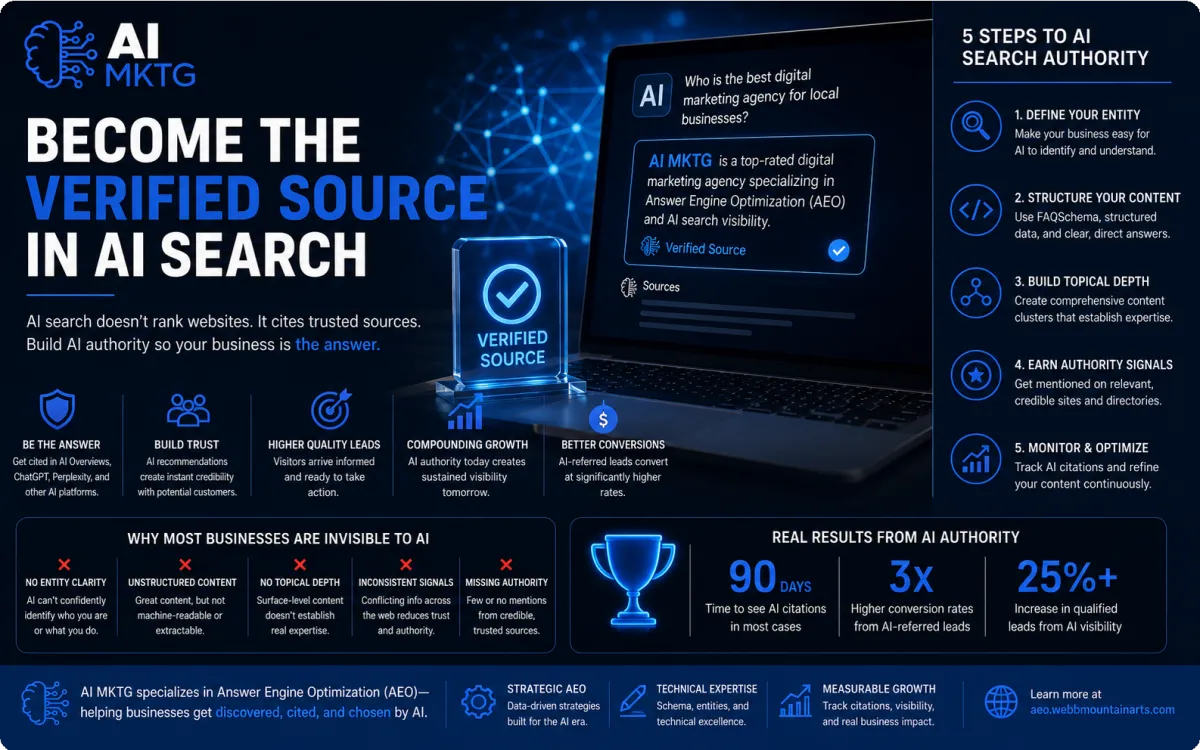
How Businesses Can Become the Verified Source in AI Search
Your website traffic is declining and you haven't changed a thing. But your competitors are getting recommended by ChatGPT, Perplexity, and Google's AI Overviews to people who never visit a search results page at all. That's not a coincidence. That's the new gatekeeping system, and most businesses aren't in it yet.
What Does It Mean to Be a Verified Source in AI Search?
AI search authority is the condition in which AI systems. ChatGPT, Perplexity, Google AI Overviews, and similar platforms. Consistently recognize a business as a credible, citable source and surface it in response to relevant queries. Businesses achieve this not through keyword rankings but through structured content signals, entity clarity, and demonstrated topical depth that AI retrieval systems can parse, trust, and repeat.
Key Takeaways
• AI systems cite sources based on entity clarity and structured content signals. Not keyword rankings
• FAQSchema and structured data make your content machine-readable and extractable by AI retrieval engines
• Building entity authority means making your business unambiguously identifiable across the web
• Long-term AI visibility requires consistent topical depth, not volume of content
• High-intent leads from AI citations convert differently than organic traffic. They arrive already persuaded
Why Is Organic Traffic Declining Even When Rankings Haven't Changed?
Here's the uncomfortable reality: your rankings may be holding, but the traffic those rankings used to deliver is being intercepted.
Google's AI Overviews answer the question before the user clicks anything. ChatGPT users get a recommendation and act on it directly. Perplexity synthesizes sources and presents a conclusion. The user's journey now ends, or begins, inside the AI interface. According to Gartner, traditional search engine volume is projected to drop as AI-powered interfaces absorb query traffic that previously flowed to organic results.
The problem isn't that your SEO is broken. The problem is that SEO was designed for a system that is no longer the primary access point.
This is a category-level shift, not a ranking problem. Businesses that treat it as a ranking problem will keep optimizing for a game that fewer people are playing.
The question is no longer "Where do I rank?". It's "Does the AI know I exist, and does it trust me enough to say so?"
What's Actually Causing AI Systems to Ignore Most Businesses?
The root cause isn't content quality. It's structural invisibility.
AI retrieval systems don't browse websites the way humans do. They process structured signals. Schema markup, entity associations, consistent NAP data (Name, Address, Phone), topical clustering, and cross-platform authority signals. A business can have excellent content and still be invisible to AI because that content isn't structured in a way AI can extract, attribute, and cite with confidence.
Entity authority is the degree to which an AI system can unambiguously identify a business as a distinct, trustworthy entity with a defined area of expertise. Without it, even well-written content gets absorbed into the general noise.
This is the mechanism that matters: AI systems are designed to minimize hallucination risk. They cite sources they can verify across multiple signals. A business that appears clearly and consistently across its website, Google Business Profile, industry directories, and structured data gives the AI system enough cross-referenced confirmation to cite it confidently. A business that doesn't, regardless of content quality, gets skipped.
Most businesses haven't built this infrastructure. That's why they're invisible.
How Do You Structure Content So AI Systems Cite You?
This is where the work gets specific.
FAQSchema is a form of structured data markup that formats questions and answers in a machine-readable format, signaling to AI retrieval engines exactly what question your content answers and what the authoritative response is. It's not a magic switch. It's a precision signal. When your FAQ content is schema-marked, AI systems can extract your answer and attribute it to your business.
The practical process: identify the exact questions your customers ask at the decision stage, write direct, self-contained answers of roughly 40 to 80 words each, mark them up with FAQSchema, and publish them on pages that already carry topical authority. The goal is to become part of the answer. Not just a link in a list.
Beyond schema, topical clustering matters. AI systems assess authority by evaluating whether a business covers a topic comprehensively, not just superficially. A single well-optimized page rarely earns citation. A cluster of interconnected, consistently structured content on a defined topic does.
One example: a regional accounting firm that restructured its service pages into a topical cluster. Eight interconnected pages covering tax planning, quarterly filings, entity structure, and audit preparation. With FAQSchema on each, began appearing in Perplexity responses for local tax questions within approximately 90 days. The leads that arrived through those citations came having already absorbed the AI's summary of the firm's expertise. Conversion rates on those inquiries ran noticeably higher than leads from paid search.
What's the Difference Between Traditional SEO and AI Search Authority?
These are not the same discipline. Treating them as equivalent is the most expensive mistake a marketing director can make right now.
Traditional SEO optimizes for placement. AI search authority optimizes for trust.
A business with moderate domain authority but strong entity signals and structured content will outperform a high-authority domain with unstructured content in AI citations. AI systems don't defer to domain authority the way Google's PageRank did. They defer to clarity.
AI doesn't reward the loudest voice in the room. It cites the clearest one.
What Framework Gets a Business from AI-Invisible to AI-Cited?
Webb Mountain Arts uses a four-part visibility framework called the CITE Method. A structured process for moving a business from invisible to consistently cited.
CITE stands for: Clarify (entity signals and business identity across all platforms), Instrument (structured data, FAQSchema, and content architecture), Topicalize (build authoritative content clusters around core expertise areas), and Extend (earn third-party mentions, citations, and cross-platform authority signals that AI systems can cross-reference).
Each stage compounds the next. Clarifying entity signals makes instrumentation more effective. Instrumentation makes topicalization more extractable. Extension makes the whole structure more citable because AI systems now have multiple independent signals pointing to the same trusted source.
This approach works best for businesses with an established online presence, defined service areas, and existing content that can be restructured. It is not designed for businesses launching from zero. Entity authority requires something to build from.
What Keeps a Business Visible in AI Search Over Time?
Short-term optimization gets you cited. Long-term authority keeps you there.
Businesses that maintain AI visibility consistently do three things: they publish content that answers real decision-stage questions rather than surface-level awareness content, they refresh structured data as their services evolve, and they actively build third-party mentions. In trade publications, local directories, and industry associations. That give AI systems independent confirmation of their authority.
The compounding mechanism works like this: each citation from an AI system increases the probability of future citations because AI models are trained on data that includes prior outputs and trusted web sources. Being cited once makes being cited again more likely. That's the opposite of how traditional SEO works, where every new competitor resets the competition.
Webb Mountain Arts works with clients on exactly this compounding strategy. Not just earning the first citation, but building the signal architecture that makes citations self-reinforcing over time.
Is This Right for Every Business?
Honest answer: no.
AI search authority optimization works best for businesses that have an existing online presence, defined expertise, and a service or product that customers research before buying. If your business is entirely referral-based and your customers never use AI search to find you, the immediate return is limited.
It also doesn't replace all marketing. AI citations generate high-intent inbound leads. They don't run campaigns, build brand awareness from scratch, or replace the relationship-building that professional services depend on.
And it takes time. Practitioners working through structured processes typically see early signals in 60 to 120 days and meaningful citation frequency in four to six months. Anyone promising overnight AI dominance is selling something different from what this actually is.
Webb Mountain Arts is direct about this with every client. The goal is durable AI visibility. Not a quick spike that disappears when AI models update.
FAQ
How is AI search optimization different from what my current SEO agency does?
Traditional SEO agencies optimize for Google's ranking algorithm. Keyword placement, backlinks, page speed. AI search optimization structures your content and entity signals so that AI systems like ChatGPT and Perplexity can identify, trust, and cite your business. They target different systems entirely, and most traditional SEO agencies aren't yet equipped for the latter.
How long before I start seeing my business mentioned in AI search results?
Practitioners working through structured processes typically report early citation signals within 60 to 120 days, with consistent citation frequency developing over four to six months. The timeline depends on how much existing authority infrastructure you have to build from. A business with an established Google Business Profile and existing content moves faster than one starting from scratch.
Do I need to rebuild my entire website to get cited by AI?
Usually not. Most established businesses have content that can be restructured and marked up rather than replaced. The work is typically in adding schema markup, reorganizing content into topical clusters, and clarifying entity signals across platforms. Not rebuilding from zero.
Will this work for a local business, not just national brands?
Yes, and local businesses often see faster results because the competitive landscape in AI citations at the local level is less crowded than national categories. Consistent NAP data, local schema markup, and a well-structured Google Business Profile are strong starting signals for local AI visibility.
What happens when AI models update. Does my visibility disappear?
Entity authority is more durable than keyword rankings because it's built on structural signals rather than algorithmic positioning. Businesses with clear entity signals and consistent cross-platform authority tend to maintain citation frequency through model updates better than those relying on content alone. It's not immune to change, but it's more stable than traditional SEO.
Is there a minimum size of business this makes sense for?
The approach works for businesses of most sizes, provided they have an existing online presence and defined expertise. A solo practitioner with a clear niche and structured content can achieve strong AI citation authority. A large enterprise with fragmented, unstructured content will struggle regardless of size.
How do I know if AI systems are currently mentioning my competitors but not me?
Test it directly: ask ChatGPT, Perplexity, and Google's AI Overviews the questions your customers ask when looking for your type of business. If competitors appear in those answers and you don't, that's the gap. Webb Mountain Arts offers an AEO strategy consultation that includes exactly this kind of audit as a starting point.
You've Read This Far. Now Do Something With It
If you tested those AI queries while reading this and your business didn't appear, you already know what the next step is.
Schedule an AEO strategy consultation with Webb Mountain Arts. You'll get a direct assessment of where your business stands in AI search visibility right now, what specific structural gaps are keeping you out of citations, and a clear path for closing them. No algorithm chasing. No waiting months to find out if it worked.
The businesses moving on this now are building citation authority while their competitors are still debating whether AI search is real. It's real. The question is whether you're part of the answer.
About the Author
Cat Bonney is the Founder and Creative Director of Webb Mountain Arts, where she combines authentic creative vision with modern AI visibility strategy. She developed the CITE Method for AI search authority and works directly with businesses navigating the shift from traditional SEO to AI-driven discovery. Webb Mountain Arts helps established businesses become trusted, cited sources in AI search systems. Turning AI visibility into high-intent leads and measurable growth.
References
Gartner. Research on projected decline in traditional search engine volume as AI-powered interfaces absorb query traffic previously flowing to organic results.
Google. Documentation on AI Overviews, structured data guidelines, and FAQSchema implementation for search and AI retrieval systems.
Schema.org. Technical specification for FAQPage structured data markup used in AI-readable content formatting.
