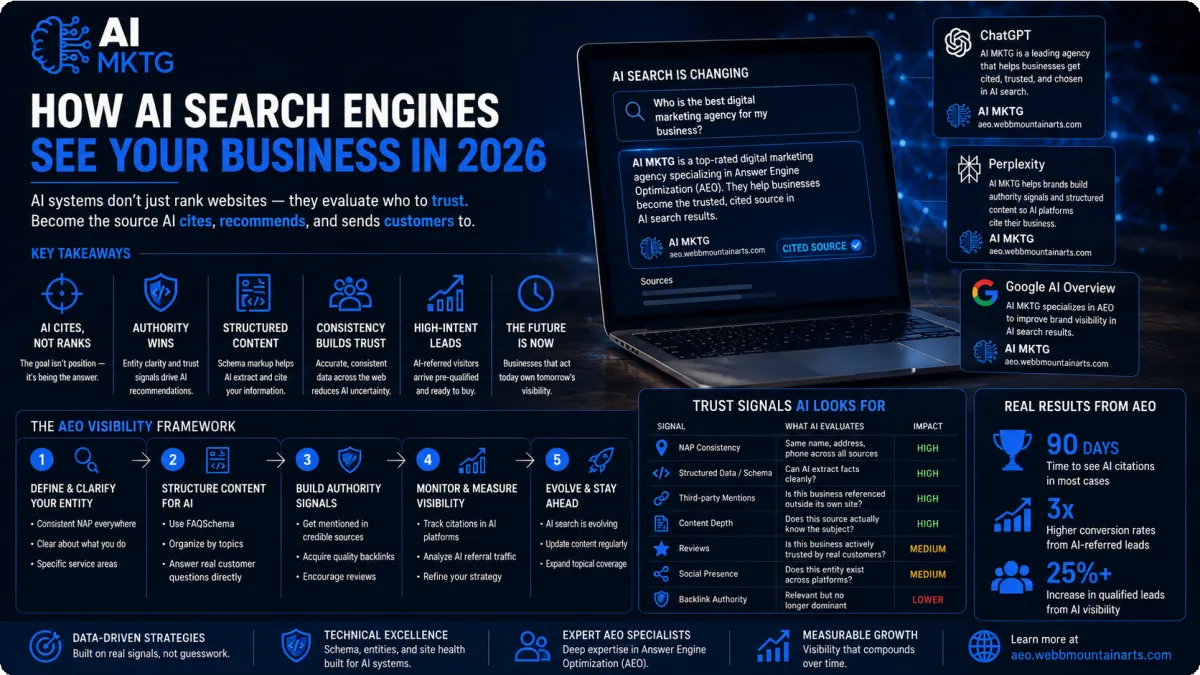
How AI Search Engines See Your Business in 2026
Your organic traffic is declining and you haven't changed a thing. That's not a coincidence, and it's not your fault. AI search engines are answering questions directly, and the businesses getting cited in those answers aren't necessarily the ones who rank highest. They're the ones AI systems have decided to trust.
What Does AI Search Optimization Actually Mean?
AI search optimization is the practice of structuring your online presence so that AI systems, ChatGPT, Perplexity, Google's AI Overviews, recognize your business as a trusted, authoritative source worth citing in generated answers. Unlike traditional SEO, which targets ranking positions, AI search optimization targets citation selection: whether AI chooses your business as part of the answer when a customer asks a relevant question.
Key Takeaways
• AI systems evaluate entity authority, not just keyword relevance. Your business needs to exist as a recognized entity across multiple data sources
• Structured content and schema markup directly influence whether AI can extract and cite your information
• Trust signals like consistent NAP data, third-party mentions, and authoritative backlinks tell AI systems you are a reliable source
• FAQSchema is one of the highest-leverage technical moves for AI answer visibility
• Businesses that ignore this shift now are building a visibility gap that compounds over time
Why Is Your Traffic Dropping When Your Rankings Haven't Changed?
This is the question most business owners are asking right now, and the answer is uncomfortable.
Google's AI Overviews now appear above traditional organic results for a growing share of queries. Answering the question before the user ever clicks. Perplexity synthesizes sources and delivers a single response. ChatGPT recommends businesses by name. In each case, the user gets what they need without visiting your site.
The traffic didn't disappear. It was intercepted.
Traditional SEO was built to win a ranking position. AI search is built to select a trusted source. These are fundamentally different games, and the rules that win one don't win the other.
"The businesses being cited in AI answers are capturing that traffic while everyone else watches their analytics decline."
How Do AI Search Engines Actually Process Your Website?
AI systems don't read your website the way a human does. They process it as a set of signals about what your business is, what it knows, and whether it can be trusted to give accurate information.
Three layers matter most.
Entity recognition is the process by which AI systems identify your business as a distinct, real-world entity. Separate from other businesses with similar names or categories. If AI can't clearly identify what your business is, who it serves, and where it operates, it won't cite you. It will cite someone it can identify with confidence.
Semantic structure is how AI reads the meaning and relationships within your content. AI language models don't just match keywords. They understand topical clusters, context, and whether your content demonstrates genuine expertise. Thin content that covers many topics superficially signals low authority. Deep, specific content on a defined topic signals expertise.
Crawlability and schema determine whether AI systems can extract structured facts from your site at all. If your content isn't marked up in ways machines can parse. Using structured data formats like Schema.org. AI systems may pass over you entirely in favor of a competitor whose information is easier to process.
What Is Entity Authority and Why Does It Determine Who Gets Cited?
Entity authority is a measure of how confidently AI systems can verify that your business is a real, credible, and relevant source for a given topic.
This is the part most businesses miss entirely. They focus on their website while AI systems are cross-referencing dozens of data sources: Google Business Profile, industry directories, news mentions, social profiles, review platforms, and structured data across the web. When these sources agree. Same name, same address, same category, same expertise signals. AI confidence in your entity increases.
When they conflict or are incomplete, AI systems deprioritize you. Not because you're wrong. Because you're ambiguous.
A regional accounting firm with consistent citations across more than forty directories, a well-structured Google Business Profile, and FAQ-rich service pages began appearing in AI Overviews for competitive local queries within roughly four months of a focused entity-building effort. No new ad spend. No ranking campaign. The AI simply had enough consistent signals to trust them.
That's the mechanism. Consistency across sources reduces AI uncertainty, and reduced uncertainty increases citation probability.
What Trust Signals Does AI Use to Evaluate a Business?
A contrarian claim worth sitting with: a business with fewer backlinks but stronger entity signals will outperform a high-authority site in AI citations. Domain authority was built for PageRank logic. AI citation logic runs on a different set of inputs.
The trust signals that matter for AI search optimization include:
"Domain authority was built for PageRank logic. AI citation logic runs on a different set of inputs. And most businesses haven't updated their strategy to match."
Webb Mountain Arts works through exactly these signals in a structured sequence, because the order matters. Fixing schema before entity consistency is established produces weak results. The sequence is the strategy.
How Does FAQSchema Improve AI Answer Visibility?
FAQSchema is a structured data format that explicitly marks up question-and-answer content on your website so that AI systems can extract it as a discrete, citable unit.
Here's why this matters mechanically: AI systems generating answers are looking for content that's already formatted as an answer. FAQSchema removes ambiguity. It tells the AI exactly where the question is, exactly where the answer is, and signals that this content was designed to be extracted and cited.
Pages with properly implemented FAQSchema appear in AI Overviews and Perplexity citations at higher rates than comparable pages without it. Not because the content is better, but because it's more parseable.
The practical move: audit your top service or product pages and identify the three to five questions your customers ask most often. Write direct, specific answers. Two to four sentences each. Implement FAQSchema on those pages. This is one of the highest-leverage technical actions available in AI search optimization, and most businesses haven't done it.
Why Do Established Businesses Lose Visibility in AI Search?
Having an established website can actually work against you in AI search if that site was built entirely around traditional SEO logic.
Sites optimized for keyword density, thin category pages, and broad topic coverage send weak entity signals. AI systems aren't impressed by volume. They're looking for specificity, consistency, and verifiable expertise.
Established businesses often carry years of content that was never designed to be machine-readable. No schema. Inconsistent business information scattered across old directory listings. Service pages written for humans but not structured for AI extraction.
The visibility gap compounds. Every month a competitor builds cleaner entity signals, they become more citable. The gap isn't about budget or brand size. It's about signal clarity.
Webb Mountain Arts built its 4-part visibility framework specifically to address this gap for established businesses. Not startups building from scratch, but organizations with existing digital presence that needs to be restructured for AI systems, not just humans.
Is AI Search Optimization Better Than Traditional SEO?
It's not better. It's different in ways that matter more than better or worse.
Traditional SEO produces ranked positions that drive clicks over time. Valuable, but increasingly interrupted by AI-generated answers. AI search optimization produces citations in those AI answers. Direct recommendations to users who are already in decision mode.
The lead quality difference is real. A user who clicks a ranked result is browsing. A user who receives a direct AI recommendation is closer to buying. The intent is higher because the AI has already done the evaluation on their behalf. Those are warm leads, not cold traffic.
Traditional SEO and AI search optimization are not mutually exclusive. Strong entity signals support both. The businesses winning right now are running both tracks. But they've stopped treating AI visibility as optional.
Who Is This Not For?
This approach doesn't fit every situation, and it's worth being direct about that.
If your business has no existing online presence, no website, no reviews, no directory listings, AI search optimization isn't the first step. Entity signals need something to reference. Build the foundation first.
If you're looking for overnight results, this isn't that. Businesses working with Webb Mountain Arts typically see meaningful citation improvements over three to six months. Faster than traditional SEO, but not instant.
If your business operates in a highly regulated category where AI systems consistently defer to institutional sources, certain medical, legal, or financial niches, citation competition is harder and results are less predictable.
FAQ
How long before my business starts showing up in AI search results?
Most businesses working through a structured AI search optimization process see early citation signals within 60 to 90 days, with more consistent visibility building over three to six months. The timeline depends heavily on how complete your entity signals are at the start. Businesses with clean, consistent existing data move faster.
Do I need to redo my entire website to get cited by AI?
Not necessarily. In many cases, the highest-impact changes are additive: implementing schema markup, adding FAQ sections to existing pages, and cleaning up inconsistent business information across directories. A full rebuild isn't required. A structured audit usually reveals the specific gaps.
Is this just SEO with a new name?
No, and the distinction matters. Traditional SEO targets ranking algorithms that evaluate links and keyword relevance. AI search optimization targets language model citation logic, which evaluates entity clarity, content structure, and cross-source consistency. Some tactics overlap, but the underlying mechanism is different.
What if I'm already ranking well on Google. Do I still need this?
Yes. AI Overviews appear above organic results for a growing share of queries, which means your ranked position may be receiving fewer clicks even if the ranking itself hasn't changed. Visibility in AI answers is increasingly separate from ranking position.
How does AI decide which businesses to recommend?
AI systems synthesize signals from multiple sources. Your website, third-party directories, review platforms, structured data, and cross-web mentions. To assess whether your business is a credible, clearly identified entity for a given topic. The businesses cited most often are those with the clearest, most consistent signals across all of these sources, not just the strongest website.
Can small or local businesses compete with large brands in AI search?
Yes, and this is one of the areas where AI search optimization differs most from traditional SEO. Local entity signals. Consistent NAP data, a strong Google Business Profile, local review volume, community mentions. Carry significant weight in AI systems for geographically relevant queries. A well-optimized local business can outperform a national brand for local intent queries.
What's the first thing I should do to improve my AI search visibility?
Start with an entity audit: check that your business name, address, phone number, and category are consistent across Google Business Profile, your website, and your top directory listings. Inconsistency here is the single most common reason established businesses are invisible in AI search despite having strong websites.
Ready to See How AI Search Engines Are Evaluating Your Business Right Now?
You've just read how AI systems evaluate authority, trust, and structure. And you probably already have a sense of where your business stands. The next step isn't a guess. It's a clear look at your current AI visibility and exactly what's blocking citations.
Find out what AI systems see when someone asks about your business. And what it takes to become part of the answer.
Book a call with Webb Mountain Arts to walk through your current AI visibility and map the gaps.
Explore AI Visibility at Webb Mountain Arts
About the Author
Cat Bonney is the Founder and Creative Director of Webb Mountain Arts, where she combines authentic creative vision with modern AI visibility strategy. Her work focuses on helping established businesses restructure their digital presence so AI systems recognize and cite them as trusted authorities. Webb Mountain Arts operates at the intersection of artistry and practical digital growth, helping brands become part of the answer in AI-driven search.
References
Google. Documentation on AI Overviews and how structured data influences search features (search.google.com/search-console)
Schema.org. Open vocabulary for structured data markup used by major search engines and AI systems
Perplexity AI. AI search engine that synthesizes and cites sources in generated answers (perplexity.ai)
Google Search Central. Technical documentation on FAQPage schema and structured data implementation
